Wilder Samsa
Insatiable Box Set: Books 1-4Wilder Samsa is the head Alpha of the Samsa family and the central political force among the werewolf packs. He is at once guardian, hunter, lawgiver, brother, father, and rival: the character who tries to prevent the werewolf world from collapsing into violence while repeatedly treating Adrienne Ward’s body, pregnancy, and mate status as matters governed by Alpha law. His importance lies in that contradiction. Wilder’s authority can protect the vulnerable and restrain brutal customs, yet it can also become possessive when he believes werewolf law gives him precedence over Adrienne’s wishes or her human marriage.
Identity and Alpha Authority
Wilder’s identity is established through physical dominance and disciplined control. When he reaches Adrienne during the bear attack, he confronts the female bear on all fours, with his canines exposed, his raised hair and fighting stance announcing the danger of an Alpha prepared to risk his life. The injured Wilder still carries Adrienne back to the cave in his jaws as he would carry a wolf pup, an action that joins ferocity with protective care. His authority is not merely physical. The young wolves in his packs respect him and yield to his Alpha status, while his brothers recognize him as the head Alpha whose decisions organize the family.
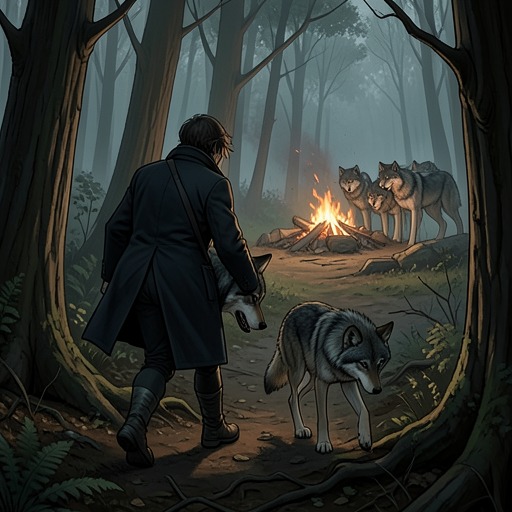
His power extends across a vast political territory. Wilder is described as the leader of a pack stretching from the Americas to Russia, and he understands leadership as an obligation to enforce werewolf law across competing communities. He is also a patient predator. At the Samsa private airstrip, he waits beneath the aircraft while Adrienne disembarks, his blue eyes appearing through the darkness as though he were stalking prey. The image captures his dual nature: civilized enough to wait and govern, animal enough to track, ambush, and kill when the law or his mate is threatened.
Protector, Reformer, and Keeper of the Packs
Wilder has devoted his life to keeping peace among packs, stopping combats, and suppressing brutal practices by male werewolves against werefemales. His reforming work began during years of travel from state to state. In Washington State, a fever killed many werefemales and left survivors sterile; male werewolves responded by slaughtering them. Wilder intervened to prevent both the males and the surviving females from being destroyed. He discovered that not every female was impotent and paid Dr. Wells and his team to preserve that knowledge in secrecy.
This history makes Wilder more than a conventional territorial Alpha. He opposes the abduction of human women because he fears that kidnapping would expose the werewolves and bring hunters against the clans. Instead, he establishes a council to address the werewolves’ breeding crisis and attempts to attract women through money, allowing them to choose whether to live with pack members. His policy is therefore protective but also strategic: survival depends on reproduction, secrecy, and the management of relations between humans and werewolves.
His reform is limited by the law he inherits. Wilder believes that werewolf customs have been internalized through generations and taught to him by his father. He can challenge slaughter and abduction while still accepting mate claims, reproductive obligations, inheritance, and Alpha precedence. The result is a plural legal order in which human marriage, Samsa family law, and werewolf custom overlap without fully agreeing. Wilder’s leadership repeatedly consists of translating between these systems, often while reserving the final authority for himself.
Adrienne Ward and the Politics of Mating
Wilder’s relationship with Adrienne begins in protection but becomes inseparable from possession. After mating with her, he tells her that she is free to come and go, yet insists that she cannot leave while pregnant because carrying his pup is dangerous. He warns that the Ari Kara clan could assassinate the child if it learns that the offspring would be his heir. His language frames restraint as protection, but it also converts Adrienne’s pregnancy into a political resource and limits her control over the child.
Wilder’s desire for Adrienne is connected to the fertility crisis. Most werefemales are sterile, and he has never found a compatible female who could accept both of his brothers and bear their pups. Because Wilder, Drayton Samsa, and Lycell Samsa are inseparable triplet Alphas, the family’s reproductive strategy requires one fertile female to become the shared center of the pack. Wilder therefore wants not only a family of his own but a future for the entire Samsa clan. He and his brothers have sworn to remain together, divide their inherited territory equally, and accept the woman Wilder selects; if Wilder dies, the next brother is expected to take and marry her.
That arrangement produces the central conflict between Wilder’s protective ideals and his patriarchal authority. When Adrienne is pregnant by Lycell, Wilder declares that he is the Alpha male, that she is his mate, and that he will marry her. Later, when Adrienne is legally married to Drayton, Wilder argues that his earlier impregnation gives him the right to take her regardless of the marriage. Adrienne rejects this claim and tells him that he sounds like Lycell. Wilder’s anger reveals how quickly his concern for pack law becomes a challenge to her consent.
Yet Wilder does eventually concede a measure of authority. To prevent conflict among the brothers, he proposes shared decision-making through a council in which two votes can override one. More significantly, he accepts that Adrienne, as the mother of their pack, has the highest decision-making power over whom she chooses to sleep with and whom she chooses to marry. This concession does not erase the coercive assumptions surrounding her, but it marks an important change: the Alpha’s unity pact can survive only if the woman at its center is granted a voice in the arrangement.
Family, Conflict, and Political Crisis
Wilder’s relationship with Drayton Samsa and Lycell Samsa is built on brotherhood, equality of inheritance, and rivalry over Adrienne. He expects their loyalty because their survival depends on remaining together, but the shared-mate system threatens to turn that unity into competition. When Lycell kills a rival wolf who had been involved in Adrienne’s kidnapping, Wilder warns that the act has created a war: the dead wolf controlled large territories in Oregon, and his pack has been left without Alphas. Wilder’s anger is therefore directed not only at Lycell’s lust and recklessness but at the political consequences that may endanger the whole Samsa family.
Wilder also defends Adrienne against Ramsey, Mena’s father, who accuses the Samsa brothers of breaking a promise and allowing a human woman to dictate werewolf law. Wilder refuses to permit Adrienne to be described as defiled and rebukes Ramsey for speaking disrespectfully about his mate. His response demonstrates the double edge of his code. He protects Adrienne from another Alpha’s claim, but he does so by asserting that she belongs within his own legal and territorial authority.
The broader danger intensifies when the Oregon and Alaska packs merge. Wilder interrupts Adrienne and Drayton’s honeymoon because the alliance threatens both humans and werewolves, and he believes Bane may be planning an attack. Later, a beta reports that Bane’s Oregon pack regards Adrienne as a threat because she is a fertile human whose children could produce a fighting force of roughly twenty males and secure Samsa dominance across North America and Europe. Wilder consequently insists that Adrienne should be accompanied whenever she leaves the compound. Protection becomes military necessity, while fertility becomes the language through which rival packs calculate power.
Pursuit of Bane and the Father’s Role
When Bane abducts Adrienne, Wilder’s response is immediate and methodical. At Bane’s compound, he orders Hunter Samsa and Devin Samsa to remain concealed near a stream while he approaches the dark log cabin alone. He is exhausted from an hour of running, lack of sleep, and lack of fresh raw meat, but he knows he must conserve strength for the confrontation ahead. His leadership here is practical rather than theatrical: he separates the young from the danger, scouts the enemy position, and accepts personal risk.
Wilder then abandons human form and shifts into a white wolf so that he can travel faster, endure the cold, and disappear against the snow. He follows frozen riverbanks because Bane may use the water to confuse his scent, but Wilder knows the tactic and continues tracking Adrienne northward. He eventually realizes that Bane is taking her to Alaska, toward a compound Wilder had dismissed as only a rumor. The pursuit turns the same animal capacities that once made him Adrienne’s rescuer into instruments of war: scent, endurance, camouflage, and the single-minded logic of the hunt.
His sons accompany the rescue effort in a revealing reversal of generations. Hunter and Devin return dressed like teenagers who have been camping with their father, despite the fact that no comparable new werewolves have been born in the Americas or Europe. Hunter gives Wilder a backpack and promises that they will bring their mother back. Wilder answers with silence and action, asking for the Range Rover and demanding to know why Robert is present. His fatherhood is therefore expressed less through tenderness than through command, preparation, and the assumption that family members must contribute to the rescue.
Change, Law, and Narrative Significance
Wilder’s defining transformation is not a rejection of Alpha law but an attempt to make that law compatible with family survival. He begins as the unquestioned center of a fraternal and reproductive system: he chooses the mate, his brothers promise to accept her, and the clan’s future depends on her fertility. The crises surrounding Adrienne, Lycell, Drayton, Bane, and the rival packs force him to recognize that absolute authority can divide the very family it is meant to preserve. His decision to share council power and acknowledge Adrienne’s priority in mate and marriage choices is the clearest institutional change in his arc.
At the same time, Wilder remains bound to a punitive conception of werewolf justice. He considers Bane’s kidnapping of an Alpha’s mate a violation demanding punishment, and he defines the final pursuit in the stark terms of hunting and being hunted: he must stop Bane before Bane can mate with Adrienne. Wilder understands himself as both man and wolf. He can reason, negotiate, and maintain peace across nations of werewolves, but under threat he becomes a hunter with one purpose. That duality gives his character its lasting tension. Wilder’s care is real, his reforms are consequential, and his devotion to the Samsa family is absolute; yet each virtue can become dangerous when filtered through possession, hierarchy, and the belief that survival authorizes control.